Does Muscle Memory Exist? The Myonuclear and Epigenetic Science of Regaining Lost Fitness
Written and reviewed by Scott Mongold, PhD — Co-Founder & CSO (Biomechanics & Neurophysiology, ULB).
Health 5 min readKey takeaways
- Muscle memory has a physical basis.
- Human muscle also an epigenetic memory.
- Previously trained people regain lost size and strength faster than untrained people.
“Muscle memory”
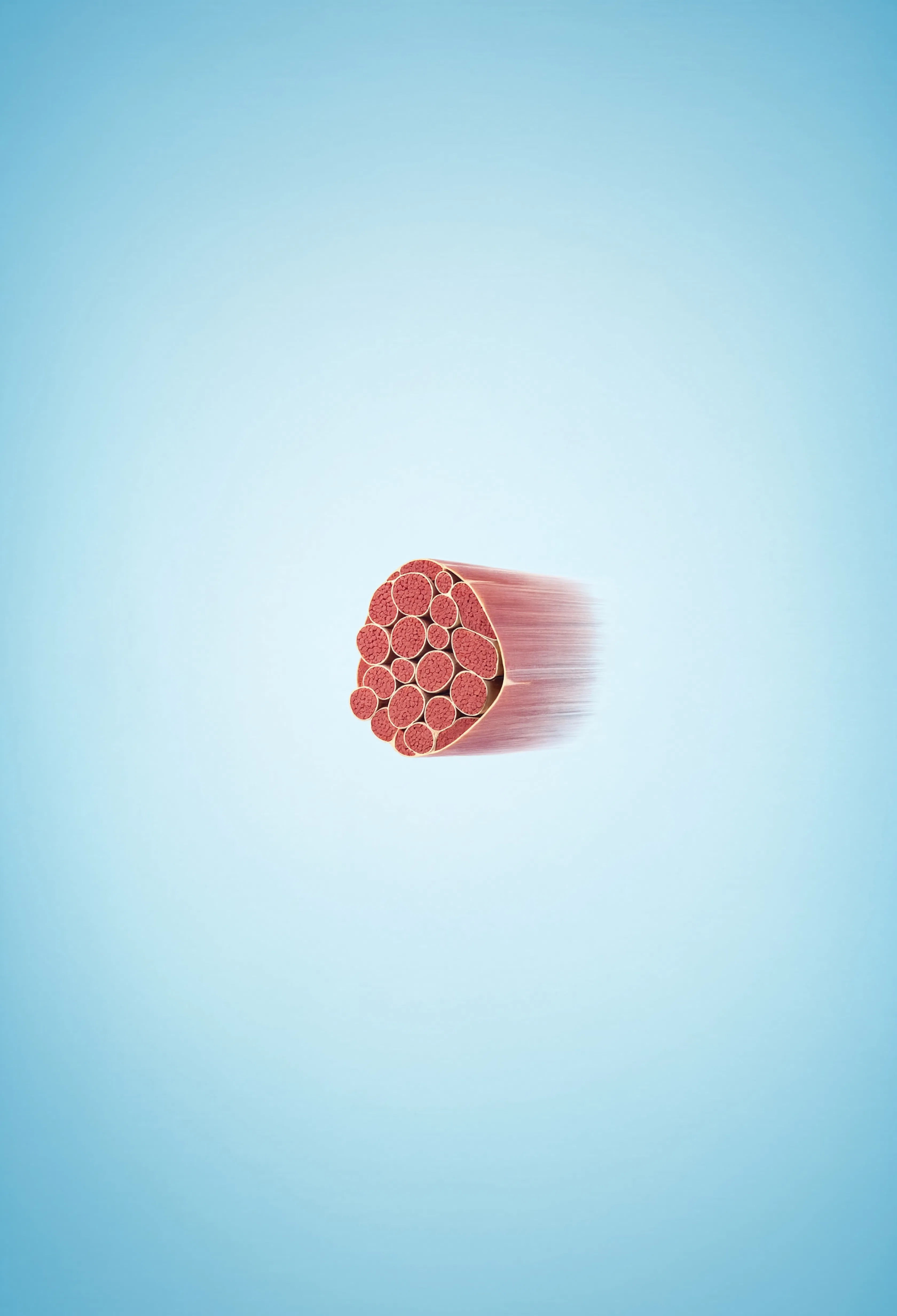
“Muscle memory” is actually two different phenomena. The first is neural: the brain and spinal cord encode motor patterns, so a movement you once knew and practiced, a clean, a swim stroke, a cycling pedal cadence, returns quickly even after time away. This is motor learning stored in the central nervous system, not in the muscle itself. It is why you can ride a bike after a decade, and why a detrained lifter re-learns coordination and intramuscular force production within a handful of sessions.
The second is structural, and it lives inside the muscle fiber. This is the more surprising and more recently mapped form of memory: the muscle tissue retains a cellular and molecular record of having been trained before. That record survives detraining, survives atrophy, and shortens the road back to strength.
This article focuses on structural memory. Two mechanisms enable this memory: retained myonuclei and persistent epigenetic marks on DNA.
Myonuclei 101
Muscle fibers are quite interesting cells: each one is enormous, multinucleated, and packed with contractile machinery. A single fiber can run the length of a muscle and house hundreds of nuclei along its length. Each nucleus governs a surrounding territory of cytoplasm, its “myonuclear domain,” supplying the genetic instructions to manufacture the proteins in that zone. More protein-building capacity in a region needs more transcriptional machinery, and that means more nuclei.
This matters because mature muscle nuclei cannot divide. To add nuclei, the fiber must recruit them from outside, from satellite cells, a reserve population of muscle stem cells that sit dormant against the fiber surface. When you overload a muscle, satellite cells activate, proliferate, and donate their nuclei to the existing fiber. The fiber now has more nuclei, more transcriptional capacity, and a higher ceiling for protein synthesis and growth.
The conventional view long held that hypertrophy and myonuclear addition rose and fell together: train and you gain nuclei; detrain and you lose them. That assumption is the crux of “use it or lose it.” The myonuclei you add appear to be far more durable than the muscle bulk they support, and that durability is the structural foundation of muscle memory.
Even through atrophy, nuclei stay present
The landmark evidence came from Bruusgaard and colleagues (2010), using time-lapse in vivo imaging of single muscle fibers in rodents. They tracked individual nuclei before, during, and after a period of overload-induced growth (including an atrophy phase).
First, myonuclei were added early, before measurable fiber growth. Nucleus number rose first; size followed. This means the nucleus is not a passive marker of a bigger fiber but a precondition, the cell builds transcriptional capacity, then grows into it. Second, and more striking, when the muscle was subsequently allowed to atrophy through inactivity, the fibers shrank dramatically but kept their elevated nucleus count. The size decreased; the nuclei stayed.
That dissociation is the cellular signature of muscle memory. A previously trained fiber that has atrophied is not the same as a never-trained fiber of equal size: it carries a surplus of nuclei, and therefore a latent capacity to rebuild quickly when overload returns. Egner et al. (2013), reinforced this: muscles that retained their myonuclear pool regrew on retraining, arguing the retained nuclei themselves drive a faster comeback. Gundersen (2016) synthesized this into a “muscle memory by myonuclei” model now widely cited.
Epigenetic memory
Myonuclei explain part of the story, but they raise a question: do the retained nuclei behave differently? Seaborne and colleagues (2018), answered this in humans by mapping DNA methylation, which are chemical tags that sit on the genome and determine whether genes are switched on or off, across a train, detrain, retrain cycle.
Participants completed seven weeks of resistance training (loading), seven weeks off (unloading) during which gains were lost, then seven weeks of retraining (reloading). They measured methylation and muscle size at each phase. The result: an earlier episode of growth left durable hypomethylation, a “switched-on-ready” state, on a set of genes associated with muscle growth, and these marks largely persisted through the detraining period despite the muscle decreasing in size. On retraining, that primed methylation profile was associated with greater hypertrophy than the first round produced.
The muscle does not merely retain hardware (extra nuclei); it retains software (so to speak), an epigenetic change that makes the growth genes easier to express the sequential time. Crucially, this persisted across a wash-out where the physical adaptation had reversed, which is the defining property of a memory: the record outlasts the thing it recorded.
Why retraining is faster than first-time training
The untrained muscle starts from scratch: it must recruit satellite cells, build myonuclei, and establish a favorable epigenetic state, all while the nervous system is still learning to coordinate the movement and recruit motor units efficiently. Progress in the first weeks is dominated by neural gains because the structural machinery is still being assembled.
The previously trained muscle skips part of this process. The extra myonuclei are already in place (, the growth-associated genes are already epigenetically primed, and the motor patterns are stored in the nervous system. Retraining seems to be less “building” and more “switching back on.”
How long does muscle memory last?
The honest answer is: longer than people assume, but not probably forever. The rodent imaging work suggests retained myonuclei persist for the equivalent of a substantial fraction of the lifespan, in human terms, plausibly years to decades for the structural nucleus pool. Once recruited, those nuclei appear remarkably resistant to loss under normal disuse atrophy.
The epigenetic layer is likely more dynamic. Methylation marks are durable but subject to slow turnover and to other lifestyle inputs, aging, inactivity, and metabolic state all reshape the methylome over time.
Whether your break is three months or three years, you are very likely returning with more cellular and molecular capacity than a true beginner. The advantage may shrink with extreme layoffs and with aging, older muscle recruits satellite cells less readily, but the floor is certainly elevated.
Practical use of muscle memory
A planned break is not cause for panic. Detraining does reduce fiber size, strength, and aerobic markers, but the structural and epigenetic memory means you are not erasing the investment, more so pausing it. The athlete who fears that two weeks off will “undo everything” should be reassured that their performance capacity will be mostly maintained.
The muscle’s primed capacity could potentially outrun the readiness of tendons, ligaments, and your recovery systems, which may not enjoy the same memory advantage. The common injury pattern after a layoff is loading the muscle to its remembered potential while connective tissue is still detrained. Expect coordination to return first, often surprisingly fast, the muscle size following over subsequent weeks. Expect the rate of re-gain to exceed your original rate of gain.
Frequently asked questions
Is muscle memory real?
Yes. The brain stores motor patterns so movement skills return quickly after time off. Structurally, muscle fibers retain myonuclei from prior training and DNA keeps epigenetic methylation marks from earlier growth.
Does muscle memory mean breaks don’t matter?
No. It means breaks cost less than feared and the cost is recoverable. You still lose size, strength, and aerobic fitness during detraining. A planned break pauses your fitness rather than erasing it, and a paced return can reclaims it efficiently.
Does muscle memory work for endurance and cardio fitness too?
Endurance adaptations show their own form of memory. Mitochondrial and metabolic gene-expression machinery, capillary networks, and trained motor patterns redevelop faster in previously conditioned athletes (all active areas of research). The principle appears to generalize: a previously trained aerobic system rebuilds faster.
Put this into practice
umo combines your wearable data with a quick neuromuscular check to build the session that fits your body today.